Victory in Europe
On May 8, 1945, Nazi Germany's unconditional surrender ended the war in Europe — a victory Canadian front pages had waited nearly six years to announce.
May 8, 1945, marked Victory in Europe Day, the moment the unconditional surrender of Nazi Germany brought an end to nearly six years of war on the European continent. For Canada, which had declared war in September 1939 and committed vast resources of men, industry, and money to the Allied cause, the day was the culmination of a national effort that had touched nearly every family in the country.
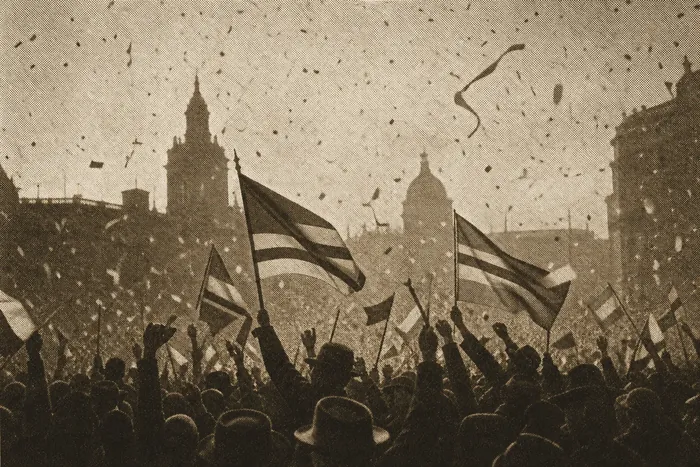
The surrender had been signed in the preceding days, and confirmation of the war’s end in Europe set off celebrations across Canada. In cities from coast to coast, crowds poured into the streets. Halifax, a port that had served as a crucial gateway for convoys crossing the Atlantic, saw enormous gatherings, as did Toronto, Montreal, and the cities of the West. The relief was profound, the joy loud and public, and for millions the day carried the sense that a long ordeal had at last been lifted.
The War Not Yet Won
Yet the front pages of that day carried an unavoidable qualification. Victory in Europe was not victory in the war. Across the Pacific, the conflict against Japan continued, and Canadian forces remained committed to a fight that would not end until August 1945. The celebrations of VE Day were therefore tempered by the knowledge that peace was still incomplete, and that further sacrifice might yet be asked.
For the newspapers, the task was to convey the magnitude of the moment while keeping that qualification in view. The essential news could be told in a few words, the plain announcement that Germany had surrendered. Around that central fact, editions gathered the reports of celebration in Canadian cities, the statements of leaders, and the reminder that the Pacific war remained to be won. The front page became a document that captured both the exhilaration and the sober awareness of the day.
The reporting reflected a country that had changed during the war years. Canada had emerged as a significant contributor to the Allied victory, its industry transformed, its armed forces vastly expanded, and its place in the world reshaped. The front pages of VE Day recorded not only the end of the fighting in Europe but, implicitly, the arrival of a nation that had grown into a more prominent role among the Allied powers.
The images and headlines of that day would become fixed in national memory: the crowds, the flags, the sense of an enormous weight set down. It was a day people would remember for the rest of their lives, and the newspapers were there to give it permanent form, to mark the date so that later generations could know exactly how it had been announced.
This front page is included in the archive because it captures a country at a hinge point, caught between celebration and the sober knowledge of work still undone. To read it is to see how Canadians were asked to understand a victory that was real, hard-won, and not yet complete, the morning a continent’s long war finally ended.
About this front page
Questions & answersWhich newspaper front page announced Victory in Europe, and on what date?
The plate reconstructs the front page of the Toronto Daily Star of Toronto, in an Extra edition, dated 8 May 1945. That day marked Victory in Europe Day, when the unconditional surrender of Nazi Germany ended nearly six years of war on the European continent.
How did Canadians respond to news of the surrender?
Confirmation of the war's end in Europe set off celebrations across Canada, with crowds pouring into the streets in cities from coast to coast. Halifax, a crucial gateway for convoys crossing the Atlantic, saw enormous gatherings, as did Toronto, Montreal, and the cities of the West. The relief was profound and the joy loud and public.
Why did the front pages qualify the celebration of VE Day?
Victory in Europe was not victory in the war. Across the Pacific, the conflict against Japan continued, and Canadian forces remained committed to a fight that would not end until August 1945. The celebrations were therefore tempered by the knowledge that peace was still incomplete and that further sacrifice might yet be asked.
Is the page a scan of the original 1945 Toronto Daily Star?
No. It is an original typographic reconstruction of the front page, rebuilding the masthead, banner headline and dateline. It recreates how the plain announcement that Germany had surrendered was set out that day, rather than reproducing a scan of the copyrighted printed page.