A Toronto Cure for Diabetes
The spring a Toronto laboratory turned a fatal diagnosis into a manageable one — and newspapers carried word of a treatment that saved countless lives.
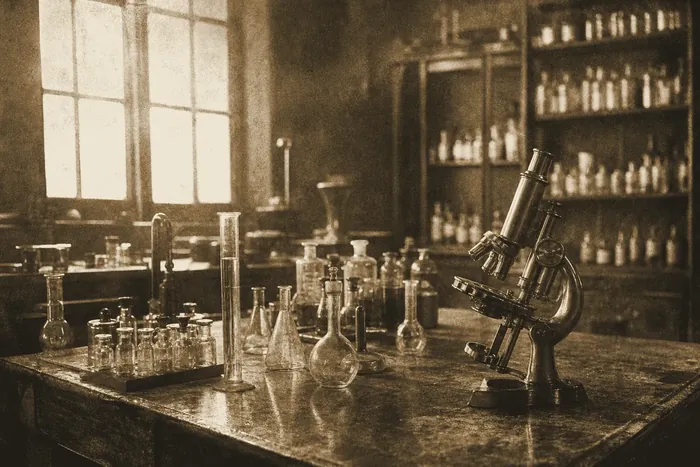
In the spring of 1922, word spread from the University of Toronto that a disease long regarded as a death sentence might be brought under control. Researchers there had isolated insulin, the hormone the body uses to regulate blood sugar, and had shown that it could be given to patients whose own bodies no longer produced enough. For readers who understood diabetes as an illness that wasted the young and the otherwise healthy, the news carried a weight that few scientific reports ever have.
The work belonged to a small group. Frederick Banting, a surgeon with an idea, and Charles Best, a student assistant, carried out the early experiments; J.J.R. Macleod provided the laboratory, direction, and resources; and the biochemist James Collip refined the extract to a purity that could be safely used in people. Their collaboration, and later the disputes over credit within it, would become part of the story, but the outcome was not in doubt: a substance that worked.
The turning point was a patient. In early 1922 a teenager named Leonard Thompson, gravely ill with diabetes, became the first person successfully treated with insulin, and his recovery offered proof that the laboratory result could translate to a human life. Before insulin, a diagnosis of the severe form of the disease meant a regime of near-starvation and, usually, death within months or a few years. After it, diabetes became a condition that could be managed over a lifetime.
From laboratory to headline
Newspapers faced the difficulty of explaining a biochemical discovery to a general audience without overstating it. The reporting of the period conveyed the essential and accurate point, that a Toronto laboratory had found a treatment for diabetes, while the medical community worked out how the extract would be produced and distributed. What made the story extraordinary was not a single dramatic morning but the steady realization, as the news travelled, that something genuinely new had arrived.
The recognition came quickly. In 1923 the Nobel Prize in Physiology or Medicine was awarded to Banting and Macleod, an unusually fast acknowledgement that reflected how immediately the discovery mattered to patients. Banting shared his portion with Best, and Macleod shared his with Collip, gestures that acknowledged the collaborative nature of the achievement. The decision to make the patent broadly available, rather than to profit narrowly from it, further shaped insulin’s reputation as a discovery given to the world.
Insulin did not cure diabetes; it made living with it possible. That distinction was understood even at the time, and it is part of why the discovery has aged so well. Generations of people have depended on the hormone first isolated in that Toronto laboratory, and the treatment remains one of the foundational advances of modern medicine.
The archive includes this page because it marks a rare kind of news, the announcement not of a disaster or a decision but of a reprieve. A front page usually records something a country must come to terms with. This one recorded something a country could be glad of: the morning readers learned that a diagnosis which had meant the end could now mean a beginning, and that the change had come from a laboratory of their own.
About this front page
Questions & answersWhich newspaper front page reported the insulin discovery, and when was it published?
The archive reconstructs the front page of The Globe of Toronto, its Morning Edition dated 3 May 1922. It carried word from the University of Toronto that a disease long regarded as a death sentence might now be brought under control.
Who was responsible for isolating insulin at the University of Toronto?
The work belonged to a small group. Frederick Banting, a surgeon, and Charles Best, a student assistant, carried out the early experiments; J.J.R. Macleod provided the laboratory, direction and resources; and the biochemist James Collip refined the extract to a purity that could be safely used in people.
What proved that insulin could work in a human patient?
In early 1922 a gravely ill teenager named Leonard Thompson became the first person successfully treated with insulin, and his recovery showed the laboratory result could translate to a human life. Before insulin, the severe form of diabetes meant near-starvation and usually death within months or a few years; afterwards it became a manageable lifelong condition.
Is the plate an image of the actual 1922 newspaper?
No. It is an original typographic reconstruction of the front page, rebuilding the masthead, banner headline and dateline in type rather than reproducing a scan of the copyrighted printed page. It is presented to convey how readers of the period first encountered the news.