A New Dominion
The first morning of a new country: four provinces became the Dominion of Canada, and readers held the announcement of a state that still exists.
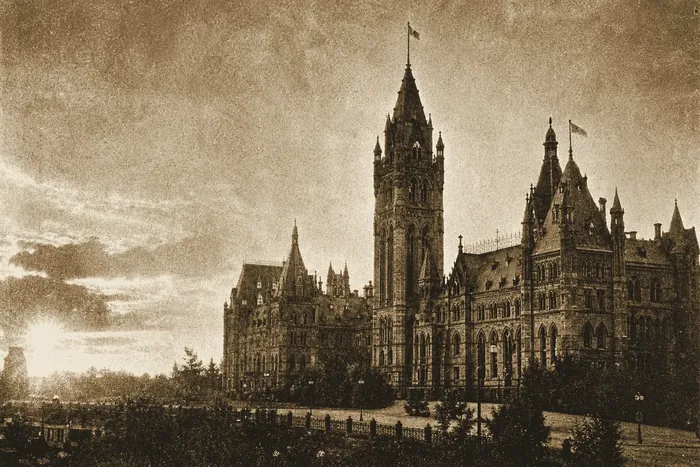
On July 1, 1867, the British North America Act took effect, and four provinces that had been separate colonies became a single country. Ontario, Quebec, Nova Scotia, and New Brunswick were joined together as the Dominion of Canada, a new political entity within the British Empire but with its own parliament and its own government. The newspapers of that morning carried the announcement of a state that has endured ever since.
Confederation had been years in the making, argued out in conferences and negotiations among colonial politicians who saw advantages in union, from defence to railways to a larger common market. The Act that resulted set out the shape of the new country: a federal structure dividing powers between a central government and the provinces, a parliament modelled on Westminster, and a framework meant to hold together regions with different histories, languages, and interests. For readers, the front page translated this constitutional machinery into a simpler fact, that they now lived in a new country.
The first government
The union came with a leader. John A. Macdonald, the Conservative politician who had been among Confederation’s principal architects, became the first prime minister of the Dominion, and the formation of the first federal government was central to the day’s reporting. Newspapers introduced readers to the men who would govern them under the new arrangement, and to the offices and institutions that would carry the country forward. The abstraction of a constitution became concrete in the persons who would administer it.
The mood recorded on the front pages was not uniform. Confederation had supporters and skeptics, and different regions greeted it with different degrees of enthusiasm; in parts of the Maritimes especially, union had been contested. The newspapers reflected a country beginning rather than a country agreed, and the coverage carried both the ceremony of the founding and the open questions about what the new arrangement would mean in practice.
It is worth remembering how much the country of 1867 was not yet the country of today. Vast western and northern territories lay outside the original four provinces, and the map would be filled in only over the decades that followed as new provinces joined and boundaries were drawn. The Dominion announced that July morning was a foundation, not a finished structure, and the front pages recorded the laying of it.
What makes the page remarkable in hindsight is its ordinariness in the moment. A country began, and it began on a printed page delivered to breakfast tables, alongside advertisements and shipping notices and the routine business of a working day. There was no way for readers to know how long the arrangement would last or what the country would become.
The archive includes this page as the birth certificate of the modern Canadian state, the morning a nation could first read its own name. A front page records how a country was asked to understand a moment; here the moment was the country itself, announced to the people who would live in it, in the plain language of the day’s news.
About this front page
Questions & answersWhich newspaper front page does this entry reconstruct, and when was it published?
It reconstructs the Morning Edition of The Globe, published in Toronto for 1 July 1867. That was the morning the British North America Act took effect, and the paper carried the announcement to readers at their breakfast tables.
What actually changed on 1 July 1867?
The British North America Act joined four previously separate colonies into one country. Ontario, Quebec, Nova Scotia and New Brunswick became the Dominion of Canada, a new political entity within the British Empire but with its own parliament and its own government. The Act set out a federal structure dividing powers between a central government and the provinces.
Who led the first federal government of the new Dominion?
John A. Macdonald, the Conservative politician who had been among Confederation's principal architects, became the first prime minister of the Dominion. Coverage introduced readers to the men who would govern them and to the new offices and institutions, making the abstraction of a constitution concrete in the persons who would administer it.
Is the front page shown here a scan of the original 1867 Globe?
No. It is an original typographic reconstruction, rebuilding the masthead, banner headline and dateline as a plate rather than reproducing a scan of the printed page. The archive presents it as a designed recreation of how the announcement appeared, not a copy of the copyrighted original.